01
Scan the domain
AAI starts by discovering pages and running a fast automated audit to identify obvious technical issues and recurring patterns.
AAI is not just a scan. It combines automated checks, AI-assisted page analysis, manual testing, developer workflow, and re-checking so accessibility work becomes visible, manageable, and provable.
Prefer a quick visual overview?
See how AAI moves from organisation setup and domain verification through scanning, manual testing, developer actions, evidence, and reporting.
The process is structured so your team can move from detected issues to confirmed actions, fixes, re-checks, and evidence.
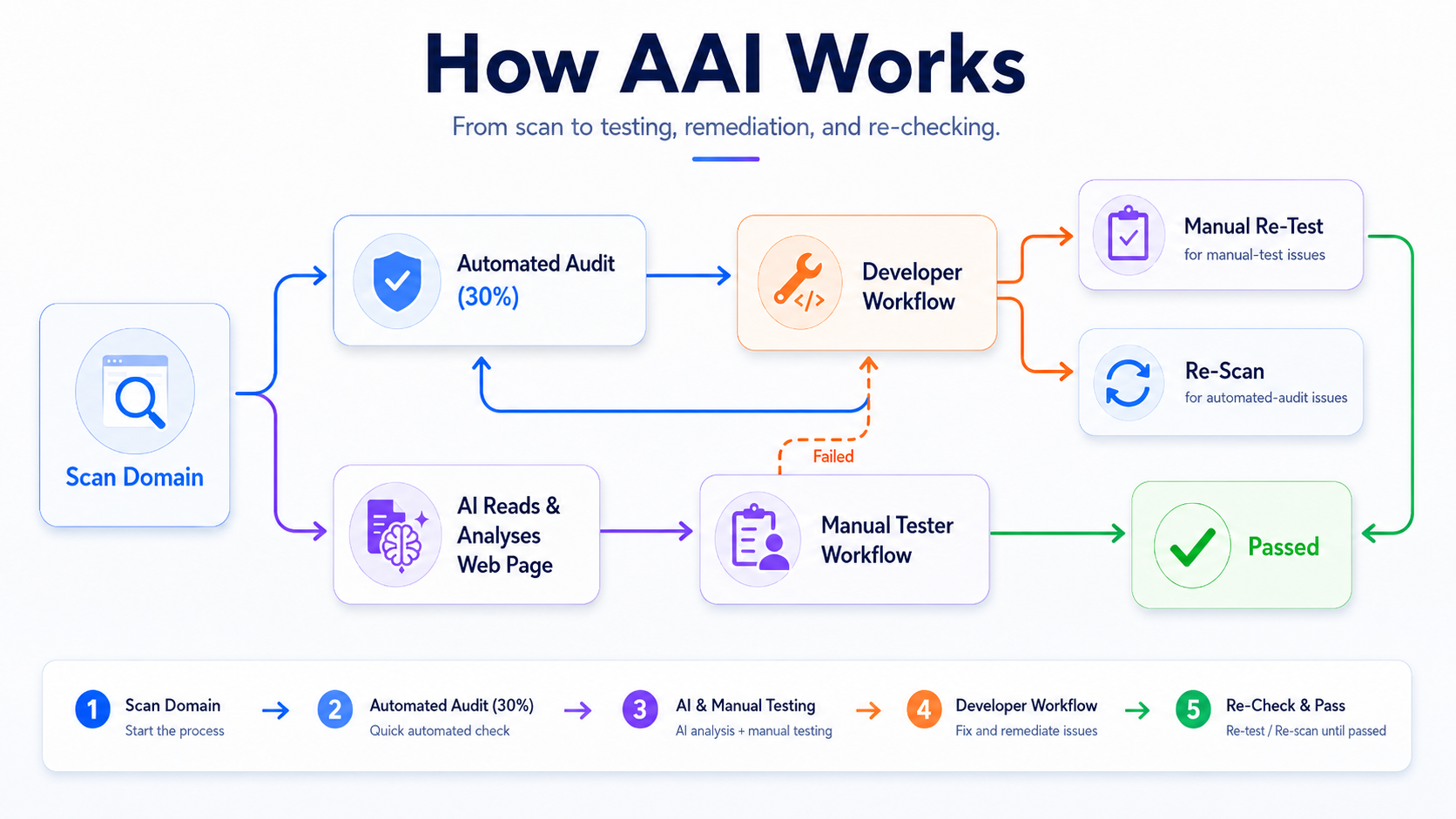
Each stage has a purpose. Automation finds fast signals. Manual testing validates what needs judgement. Developer actions make the work fixable. Re-checking helps prove progress.
AAI starts by discovering pages and running a fast automated audit to identify obvious technical issues and recurring patterns.
AAI helps interpret page structure, forms, content patterns, and likely areas that need manual validation.
Human testers check the areas automation cannot reliably prove, such as keyboard flow, instructions, form behaviour, and meaningful page experience.
Confirmed issues are turned into practical developer work, grouped by page and issue pattern so teams are not buried in raw scan noise.
Manual failures are re-tested and automated failures are re-scanned, giving the organisation evidence that fixes worked.
AAI preserves scan history, manual testing notes, developer actions, retest outcomes, and reporting context at page level.
The goal is not to overwhelm your team with findings. The goal is to organise accessibility work so it can be understood, assigned, fixed, re-checked, and reported.